When it comes to investing in the stock market, most beginners in India face one common confusion: should they go for intraday trading or delivery trading? Both methods have their own pros, cons, and strategies. If you are just starting out, it is extremely important to understand the Difference Between Intraday and Delivery Trading, explained in detail, so that you can decide which option suits your financial goals, lifestyle, and risk appetite.
Difference Between Intraday and Delivery Trading Explained
In this comprehensive article, we will break down the basics, benefits, risks, and strategies of both intraday and delivery trading. By the end of this read, you will have a clear idea of which approach works best for you. And if you are serious about learning how to trade, we will also guide you on how to start your journey with the Best Stock Market Learning Institute in Kolkata – Moolance Academy.
1. What is Intraday Trading?
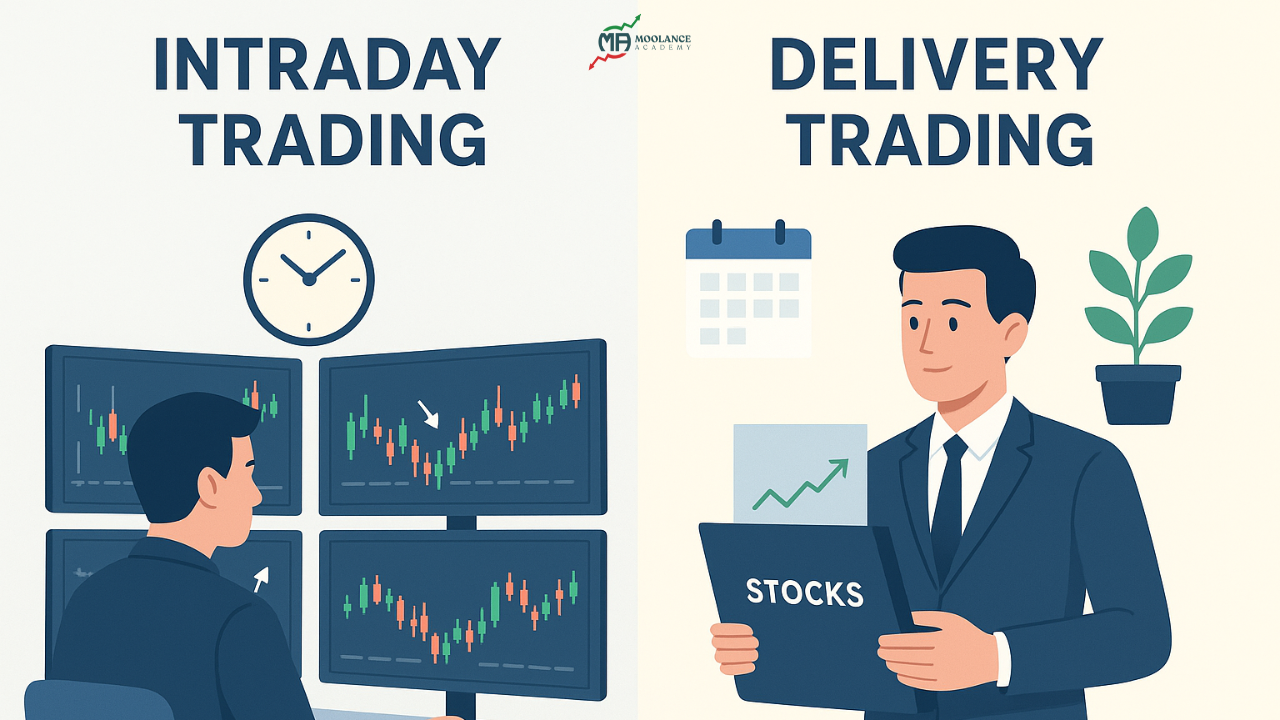
Intraday trading means buying and selling shares on the same day, before the market closes. You don’t take delivery of shares in your Demat account; instead, all trades are squared off by the end of the trading session.
For example, if you buy 100 shares of Infosys at 10:30 AM and sell them at 2:00 PM the same day, you are doing intraday trading.
- Purpose: To make quick profits from small price movements.
- Timeframe: Minutes to hours, but always within the same day.
- Risk level: High, because prices can be volatile.
2. What is Delivery Trading?
Delivery trading means buying shares today and holding them in your Demat account for more than one day. You become a shareholder of the company until you decide to sell.
For example, if you buy 100 shares of Reliance and hold them for a year before selling, that’s delivery trading.
- Purpose: To create long-term wealth and build a portfolio.
- Timeframe: Days, months, or years.
- Risk level: Lower compared to intraday, as you can hold until prices recover.
3. The Core Difference Between Intraday and Delivery Trading Explained
To make things easier, let us put the Difference Between Intraday and Delivery Trading Explained in simple points:
- Ownership: In intraday trading, you never own the shares. In delivery trading, shares are yours until you sell.
- Timeframe: Intraday = within the same day, Delivery = hold for longer.
- Risk & Reward: Intraday is riskier but can give quick profits. Delivery is safer but profits take time.
- Capital Requirement: Intraday needs less margin money (leverage available). Delivery requires full investment.
- Brokerage: Intraday brokerage is usually lower, while delivery may have higher charges depending on the broker.
4. Advantages of Intraday Trading
- Quick Profits: You can earn daily from market fluctuations.
- Lower Capital Requirement: Leverage and margin trading allow small capital to control big positions.
- No Overnight Risk: Since positions close the same day, you avoid risks of after-market news/events.
- Great for Active Traders: If you can monitor charts daily, intraday is rewarding.
5. Disadvantages of Intraday Trading
- High Risk: Sharp movements can wipe out capital.
- Requires Constant Monitoring: You need to track the market throughout the session.
- Emotional Stress: Quick decision-making can lead to panic.
- Not for Beginners: Without proper training, most traders lose money.
6. Advantages of Delivery Trading
- Long-Term Wealth Creation: Best for building a solid portfolio.
- Dividend & Bonus Benefits: As a shareholder, you enjoy company rewards.
- No Time Pressure: You can hold as long as you want.
- Less Stressful: You don’t have to monitor the market minute by minute.
7. Disadvantages of Delivery Trading
- High Capital Requirement: No leverage; you need the full amount to buy shares.
- Slow Returns: Profits take months or years.
- Market Risk: If stock underperforms for years, your capital stays blocked.
- Brokerage & Taxes: Long-term charges can add up if you trade frequently.
8. Which One Should You Choose?
Now that you know the Difference Between Intraday and Delivery Trading Explained, the next step is deciding which suits you.
- Choose Intraday Trading if:
- You have time to monitor the market daily.
- You can handle risks and losses.
- You want quick, short-term profits.
- You have time to monitor the market daily.
- Choose Delivery Trading if:
- You are looking for long-term wealth creation.
- You don’t want daily stress.
- You want ownership benefits like dividends.
- You are looking for long-term wealth creation.
Many successful traders in India actually use a mix of both – intraday for short-term cash flow and delivery for long-term wealth.
9. Tax Implications in India
Another important factor in the Difference Between Intraday and Delivery Trading Explained is taxation.
- Intraday Trading Profits: Treated as business income, taxed as per your income slab.
- Delivery Trading Profits:
- Short-Term Capital Gains (STCG) = 15% tax if held for less than 1 year.
- Long-Term Capital Gains (LTCG) = 10% tax above ₹1 lakh profit if held more than 1 year.
- Short-Term Capital Gains (STCG) = 15% tax if held for less than 1 year.
10. Risk Management Strategies
- For Intraday Trading:
- Always use stop-loss.
- Trade with only 1–2% of your total capital per trade.
- Avoid over-leveraging.
- Always use stop-loss.
- For Delivery Trading:
- Diversify across sectors.
- Invest in fundamentally strong companies.
- Have patience; don’t panic during market corrections.
- Diversify across sectors.
11. Real-Life Example: Intraday vs Delivery
Let’s say you buy 100 shares of TCS at ₹3,500.
- In intraday, if it goes up to ₹3,550, you sell the same day and make ₹5,000 profit. But if it drops to ₹3,450, you lose ₹5,000 quickly.
- In delivery, even if the price drops today, you can hold for months. If after a year TCS rises to ₹4,200, you make ₹70,000 profit.
This simple example highlights the Difference Between Intraday and Delivery Trading Explained clearly.
12. Common Mistakes Beginners Make
- Trading without knowledge or training.
- Not understanding the risk involved in intraday.
- Selling delivery stocks too early out of fear.
- Not diversifying investments.
- Ignoring the importance of learning from professionals.
13. Why You Must Learn Before Trading
Both intraday and delivery trading require a solid foundation in stock market concepts. Many beginners in India lose money simply because they jump in without proper training. There are multiple reasons why should you learn stock market.
This is why joining the Best Stock Market Learning Institute in Kolkata – Moolance Academy can transform your trading journey. With structured offline courses, expert mentors, and real-market case studies, you will gain the confidence to trade wisely.
14. Conclusion: Difference Between Intraday and Delivery Trading Explained
The Difference Between Intraday and Delivery Trading Explained lies mainly in timeframe, ownership, risk, and capital requirement. Intraday is for short-term profits with higher risks, while delivery is for long-term wealth with relatively lower risks.
Whichever option you choose, remember — success in the stock market depends on proper knowledge, discipline, and practice. Don’t jump blindly into trading without guidance.
If you are serious about learning how to trade and invest like a pro, join Moolance Academy – the Best Stock Market Learning Institute in Kolkata. Whether you want to master intraday trading or delivery investing, their expert-designed offline courses will give you the clarity and confidence you need.
Recommended Read: Online vs Offline Stock Market Courses
👉 Want to master intraday and delivery trading?
👉 Looking for the Best Stock Market Learning Institute in Kolkata?
💡 Join Moolance Academy today and transform your financial future.
🌐 Visit: www.moolanceacademy.com